










The Triple Agonist: Retatrutide & the Next Frontier of Weight Loss
In December 2025, Eli Lilly announced results from the first successful Phase 3 trial of retatrutide — and the numbers were extraordinary. Patients on the highest dose lost an average of over 70 pounds. More than one in eight reported being completely free of knee pain. Cardiovascular risk markers improved across the board. The obesity medicine world hasn't seen numbers like these before.
But what exactly is retatrutide, how does it work, and what do the trials actually tell us? Here is a comprehensive look at everything we know so far.
What Is Retatrutide?
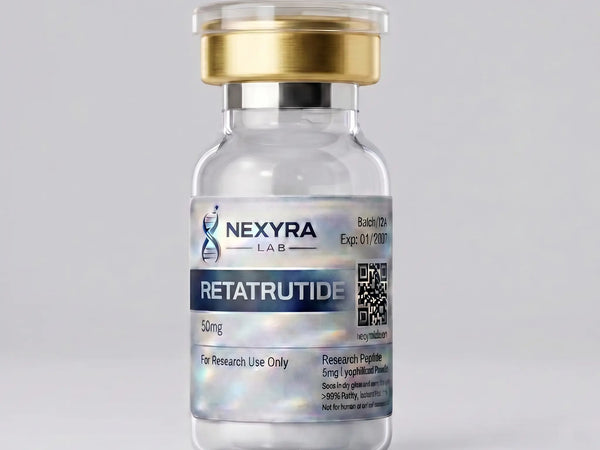
Retatrutide (research name: LY3437943) is an investigational once-weekly injectable medication developed by Eli Lilly. It belongs to a new class of drugs called triple hormone receptor agonists — meaning a single molecule simultaneously activates three separate hormonal pathways in the body.
Those three targets are the receptors for glucose-dependent insulinotropic polypeptide (GIP), glucagon-like peptide-1 (GLP-1), and glucagon (GCG). To understand why that matters, it helps to look at how existing medications work by comparison. Semaglutide (Wegovy/Ozempic) targets only GLP-1. Tirzepatide (Zepbound/Mounjaro) targets GLP-1 and GIP. Retatrutide targets all three.
The addition of glucagon receptor activation is what sets retatrutide apart. Glucagon is a hormone that increases energy expenditure and promotes fat breakdown — effects that complement the appetite-suppressing and insulin-sensitizing properties of GLP-1 and GIP. The result, at least in trials, is a drug that appears to drive substantially greater weight loss than either of its predecessors.
From Phase 1 to Phase 3: The Clinical Journey
Retatrutide's development has moved through the traditional pipeline with impressive speed and consistent results at each stage.
2021–2022: Phase 1b — First Human Data In a trial involving patients with type 2 diabetes, the highest dose (12 mg) produced a placebo-adjusted weight reduction of approximately 10% in just 12 weeks — a strong early signal.
2021–2022: Phase 2 — NEJM Publication A landmark Phase 2 trial published in the New England Journal of Medicine showed 24.2% average body weight reduction at 48 weeks on the 12 mg dose. 100% of participants lost at least 5% of body weight; 63% lost at least 20%. The TRIUMPH Phase 3 program was launched on the strength of these results.
2023–2025: Phase 3 TRIUMPH Program Launches Eli Lilly initiated a sweeping Phase 3 program encompassing multiple conditions: obesity, type 2 diabetes, cardiovascular outcomes, knee osteoarthritis, obstructive sleep apnea, chronic low back pain, and metabolic liver disease. Over 5,800 participants were enrolled across the program.
December 2025: TRIUMPH-4 — First Phase 3 Readout Positive topline results were announced for the obesity and knee osteoarthritis trial. The 12 mg dose produced 28.7% average body weight loss and a 75.8% reduction in knee pain scores at 68 weeks.
2026: Seven Additional Phase 3 Readouts Expected Results from trials targeting obesity, type 2 diabetes, cardiovascular disease, sleep apnea, and other conditions are anticipated throughout 2026.
2027 (Projected): Potential FDA Approval If Phase 3 data supports an NDA filing and the standard FDA review timeline holds, approval could arrive as early as 2027 — though delays are always possible.
Breaking Down the Numbers
The headline figures from the TRIUMPH-4 Phase 3 trial are striking on their own, but context makes them even more impressive.
- 28.7% — average body weight lost on the 12 mg dose at 68 weeks
- 71.2 lbs — average absolute weight loss in pounds
- 75.8% — improvement in WOMAC knee pain scores
- 14 mmHg — reduction in systolic blood pressure on the 12 mg dose
For comparison, the Phase 2 trial published in the New England Journal of Medicine already showed 24.2% weight loss at 48 weeks. The Phase 3 numbers exceeded even those results, with the longer 68-week duration producing more absolute loss.
"We are encouraged by the results of TRIUMPH-4, which highlight the powerful effect of retatrutide — a first-in-class triple agonist — on body weight, pain and physical function." — Kenneth Custer, Ph.D., Executive VP, Eli Lilly Cardiometabolic Health
How Does It Compare to Existing Drugs?
No head-to-head trials exist yet, so comparisons come with important caveats — different trial populations, durations, and designs make direct equivalences imprecise. That said, the directional picture from available data is consistent:
- Retatrutide 12 mg (Phase 3, 68 weeks): ~28.7% body weight loss
- Retatrutide 12 mg (Phase 2, 48 weeks): ~24.2% body weight loss
- Tirzepatide (SURMOUNT-1, 72 weeks): ~22.5% body weight loss
- Semaglutide/Wegovy (STEP, 68 weeks): ~14.9% body weight loss
⚠ Cross-trial comparisons only. Different populations, durations, and designs. Not head-to-head data.
Beyond Weight Loss: A Whole-Body Effect
What's particularly striking about retatrutide's trial data is how broad its metabolic impact appears to be. Weight loss is the headline, but the secondary endpoints in TRIUMPH-4 tell a more comprehensive story.
Participants on retatrutide showed clinically meaningful improvements in non-HDL cholesterol, high-sensitivity C-reactive protein (a key marker of inflammation), and triglycerides. At the 12 mg dose, systolic blood pressure fell by 14 mmHg. Earlier Phase 2 data suggested visceral fat — the metabolically dangerous fat surrounding internal organs — decreased by approximately 42%, exceeding the percentage of total weight loss.
The osteoarthritis benefits were equally notable. In a post-hoc analysis, more than one in eight patients on retatrutide reported being completely free from knee pain at week 68, compared with just 4.2% on placebo. Lilly is explicitly studying whether this could position retatrutide as the first weight-loss medication labeled to delay or prevent total knee replacement surgery.
The glucagon receptor component of retatrutide is thought to increase resting energy expenditure and drive fat oxidation through pathways that are distinct from GLP-1 and GIP. This may explain why retatrutide produces greater weight loss even compared to tirzepatide, which already combines two receptors. The triple-agonist approach appears to be genuinely additive, not redundant.
Safety Profile: What We Know So Far
Like other drugs in the incretin class, retatrutide's most common adverse events are gastrointestinal. These are familiar to anyone who has followed the GLP-1 space: nausea, diarrhea, constipation, and vomiting. They tend to be most pronounced during the dose-escalation period and generally resolve over time.
- Nausea: 43.2% (12 mg) vs. 10.7% placebo
- Diarrhea: 33.1% (12 mg) vs. 13.4% placebo
- Constipation: 25.0% (12 mg) vs. 8.7% placebo
- Vomiting: 20.9% (12 mg)
A New Safety Signal: Dysesthesia
TRIUMPH-4 surfaced something that Phase 2 had not: dysesthesia — an abnormal, sometimes painful sensation of touch — occurred in 8.8% of patients on the 9 mg dose and 20.9% on the 12 mg dose, compared with only 0.7% on placebo. This is a meaningful signal that analysts and regulators will scrutinize closely in the remaining Phase 3 readouts.
Lilly reports that these events were generally mild and rarely led to discontinuation. But the signal was absent in Phase 2 and could affect labeling or patient selection if it persists across the broader TRIUMPH program.
Overall discontinuation rates were 12.2% (9 mg) and 18.2% (12 mg), compared with 4% for placebo. Notably, some discontinuations were attributed to "perceived excessive weight loss" — a phrase that underscores just how potent the drug's effects are at the highest dose.
The TRIUMPH Program: What's Still Coming
TRIUMPH-4 is only the beginning. Lilly has seven additional Phase 3 readouts expected throughout 2026, each targeting a different medical context:
- TRIUMPH-1: Obesity (pivotal registration trial) — primary endpoint: % body weight change
- TRIUMPH-2: Obesity + Type 2 Diabetes — weight loss & HbA1c reduction
- TRIUMPH-3: Cardiovascular outcomes in high-risk patients — MACE reduction
- TRIUMPH-4 ✓: Obesity + Knee Osteoarthritis — weight + WOMAC pain score (completed)
- TRIUMPH-5: Obstructive Sleep Apnea — AHI reduction
- TRIUMPH-6: Chronic Low Back Pain — pain score + function
- TRIUMPH-7: Metabolic Liver Disease (MASH) — liver fat & fibrosis
- TRIUMPH-8: Renal Outcomes — eGFR / proteinuria
When Could It Be Available?
Retatrutide is not FDA-approved and is currently only accessible through clinical trials. Based on Lilly's projected Phase 3 completion timeline and the standard FDA review process of 10–12 months, the earliest realistic path to approval is 2027 — assuming all remaining trials succeed, no major new safety signals emerge, and the regulatory submission process moves smoothly.
For comparison: tirzepatide received FDA approval for diabetes (Mounjaro) in May 2022 and for obesity (Zepbound) in November 2023, after similarly strong Phase 3 data. The pipeline from final trial completion to approval typically spans 12–24 months.
Compounding pharmacies have been offering unauthorized versions of retatrutide, similar to what happened with semaglutide and tirzepatide during supply shortages. Medical authorities strongly caution against this: the drug's long-term safety profile is still being established, and compounded versions carry serious risks around purity and dosing.
The Bottom Line
Retatrutide represents a genuine scientific leap in obesity pharmacology. By targeting a third hormone receptor — glucagon — on top of the GLP-1 and GIP pathways that already underpin the most effective weight-loss drugs on the market, Lilly has created a molecule that appears to push the ceiling of pharmacological weight loss higher than anything previously documented.
The Phase 3 TRIUMPH-4 results — over 28% average body weight loss at 68 weeks, dramatic reductions in knee pain, and broad metabolic improvements — are the most compelling obesity trial data ever published. If the remaining seven Phase 3 readouts hold up, retatrutide could enter the market as a treatment not just for weight, but for the full constellation of complications that obesity drives: joint disease, cardiovascular risk, sleep apnea, liver disease, and diabetes.
The dysesthesia signal is a genuine unknown that deserves monitoring. But the trajectory, for now, is unmistakably upward.
We are living through a transformation in how medicine understands and treats obesity. Retatrutide may be its most powerful expression yet.
Disclaimer: This post is for informational and educational purposes only. It is not medical advice. Retatrutide is an investigational drug not yet approved by the FDA or any other regulatory agency. Consult a licensed healthcare professional before making any decisions about medication or treatment. Sources: Eli Lilly TRIUMPH-4 press release (Dec. 2025) · NEJM Phase 2 trial (Jastreboff et al., 2023) · ClinicalTrials.gov · BioSpace, PharmExec (Dec. 2025)